
The healthcare industry stands on the edge of a technological revolution, with advances in artificial intelligence (AI) promising new levels of precision, efficiency, and personalization. Yet, the foundation of this transformation—healthcare data—remains fragmented and siloed across institutions, systems, and devices, limiting AI’s ability to unlock its full potential. This post dives into the challenges of the current healthcare data landscape, explores FHIR and TEFCA as crucial steps toward solving these challenges, and imagines a future where seamless data integration enables groundbreaking AI-assisted care.
The Challenges of Fragmented Healthcare Data
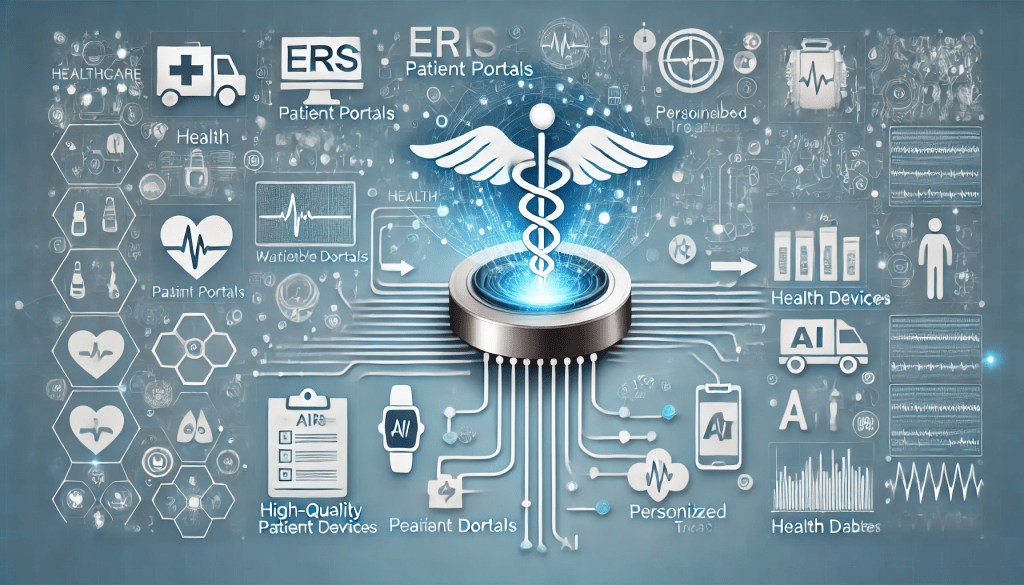
Healthcare data is currently scattered across numerous platforms and systems, from electronic health records (EHRs) and laboratory databases to wearable health devices and patient portals. This data fragmentation not only complicates data sharing between healthcare providers but also disrupts patient care continuity. Each institution often operates within its own set of standards and data formats, leading to a lack of interoperability—where one healthcare system cannot seamlessly exchange data with another.
For clinicians, the implications are significant. Imagine a cardiologist assessing a new patient with a history of atrial fibrillation (AF) whose prior data resides in a different health network. Without an efficient way to access these records, the cardiologist’s decision-making relies on limited information, potentially impacting care quality. Moreover, as healthcare data remains siloed, the volume of unstructured and inaccessible data grows, slowing down AI algorithms that thrive on high-quality, interconnected data.
In essence, AI can’t do its job if it can’t access the right information. A fragmented data ecosystem limits not only real-time clinical insights but also stifles long-term advancements like predictive analytics and precision medicine. If we want AI to help healthcare evolve, the data landscape must evolve first.
Why FHIR and TEFCA Are Critical to the Future of Healthcare Data
To address the challenges of fragmented healthcare data, standards like FHIR (Fast Healthcare Interoperability Resources) and frameworks like TEFCA (Trusted Exchange Framework and Common Agreement) are emerging as promising solutions.
Fast Healthcare Interoperability Resources (FHIR)
FHIR, developed by HL7, aims to standardize how healthcare data is structured, stored, and shared. Imagine it as a common language that enables disparate health systems to talk to each other. FHIR’s modular and flexible design makes it particularly well-suited for integration across a wide range of healthcare applications. This flexibility is essential in today’s world, where health data comes from various sources, from clinical databases to wearable devices and even mobile health apps.
One of the best ways to understand FHIR’s significance is to compare it with Apple HealthKit. HealthKit allows various health apps and devices to input data into a single ecosystem where users can access their entire health picture in one place. For example, users can view data from a fitness tracker, a nutrition app, and a blood pressure monitor all within Apple Health. This harmonization enables individuals to get a comprehensive view of their health without manually pulling data from each app.
FHIR seeks to accomplish this on a much larger scale in clinical settings. By adopting FHIR, healthcare organizations could create a consolidated patient profile, allowing providers to access a patient’s comprehensive history regardless of where the data originated. However, implementing FHIR across healthcare institutions will require collaboration, investment in technology upgrades, and strong regulatory support to maintain security and privacy.
Trusted Exchange Framework and Common Agreement (TEFCA)
Where FHIR focuses on data standards, TEFCA tackles the issue of governance. TEFCA, introduced by the Office of the National Coordinator for Health Information Technology (ONC) in the United States, aims to create a standardized framework for nationwide data sharing. While FHIR provides the technical “language” for data exchange, TEFCA creates the “rules” to ensure data sharing is conducted in a safe, secure, and consistent manner.
By setting protocols for data exchange and defining security guidelines, TEFCA seeks to establish a trusted network where healthcare providers, patients, and other stakeholders can access and share data with confidence. In this sense, FHIR and TEFCA work in tandem: FHIR facilitates the technical side of data sharing, while TEFCA ensures that shared data is accessible, consistent, and governed by uniform regulations.
The Road to Implementation
Implementing FHIR and TEFCA on a large scale will not be easy. Here are some of the key steps that healthcare systems will need to take:
- Infrastructural Overhaul: Many existing EHR systems are outdated and lack the capacity to support FHIR-based interoperability. Healthcare organizations will need to invest in upgrading their infrastructure to accommodate these standards, which may require significant time and financial resources.
- Data Standardization Efforts: Even with FHIR and TEFCA, healthcare data needs to be organized and cleaned. This includes standardizing data entry protocols, digitizing paper records, and implementing data governance frameworks that address issues of redundancy, inconsistency, and data accuracy.
- Stakeholder Collaboration: Successful interoperability requires cooperation between healthcare providers, technology vendors, policymakers, and even patients. Stakeholders must work together to prioritize data-sharing initiatives, agree on data usage guidelines, and promote widespread adoption of FHIR and TEFCA.
- Education and Training: Integrating FHIR and TEFCA means changing the way healthcare professionals interact with data. Hospitals and health networks will need to provide training to ensure clinical teams understand the new data-sharing capabilities and how to leverage them for better patient outcomes.
Looking to the Future: How AI-Driven Models Like Med-PaLM Will Transform Healthcare
As healthcare data becomes more accessible and standardized, large multimodal foundation models can finally start to integrate into the system. Models like Med-PaLM, developed by Google Research, are examples of AI tools designed to assist healthcare professionals in analyzing multimodal data—text, images, lab results, and more—to deliver precise, data-driven insights.
Med-PaLM, a multimodal model, is trained on a vast dataset of clinical information, including medical text, diagnostic images, and clinical notes. With access to harmonized and structured data, Med-PaLM could assist clinicians in diagnosing complex cases, offering a “second opinion” by identifying patterns and suggesting treatment options based on the latest research and case studies. It has been developed to support clinical decision-making, synthesizing information from various parts of the patient record to provide holistic insights.
The potential of these AI models lies in their ability to bring together multiple types of data more efficiently than any human could, quickly identifying connections and patterns that might otherwise go unnoticed. With standardized data flow powered by FHIR and TEFCA, these models can operate across healthcare systems, contributing to faster diagnoses, improved patient outcomes, and more efficient healthcare administration.
Conclusion
The path toward integrated, AI-driven healthcare is challenging but achievable. By embracing standards like FHIR and governance frameworks like TEFCA, the healthcare industry can break down the barriers of data fragmentation, creating a streamlined, interoperable ecosystem. With accessible, high-quality data, AI models like Med-PaLM will have the foundation they need to support clinicians, transform patient care, and usher in a new era of precision medicine.
In a future where data flows seamlessly, AI won’t just assist—it will empower healthcare professionals to deliver better, more personalized care than ever before.

 Cardio Cypher