
The concept of digital twins is rapidly transforming healthcare, offering dynamic, data-driven models that mirror the physiological and pathological states of patients. These virtual replicas allow clinicians to simulate treatments, predict disease progression, and optimize healthcare delivery, paving the way for personalized medicine. Originally pioneered in the aerospace and manufacturing industries, digital twin technology is now making inroads into biomedicine, fueled by advances in artificial intelligence (AI), high-performance computing, and real-time data acquisition.
A digital twin is more than just a simulation—it is a continuously evolving, real-time model that adapts based on incoming data from a variety of sources, including electronic health records (EHRs), wearable devices, imaging scans, and genetic profiles. This capability makes digital twins invaluable for improving diagnostics, treatment planning, and hospital operations. As computational models become more sophisticated, digital twins will likely become indispensable tools in precision medicine, helping clinicians tailor interventions based on a patient’s unique biology rather than relying on population-wide treatment paradigms.
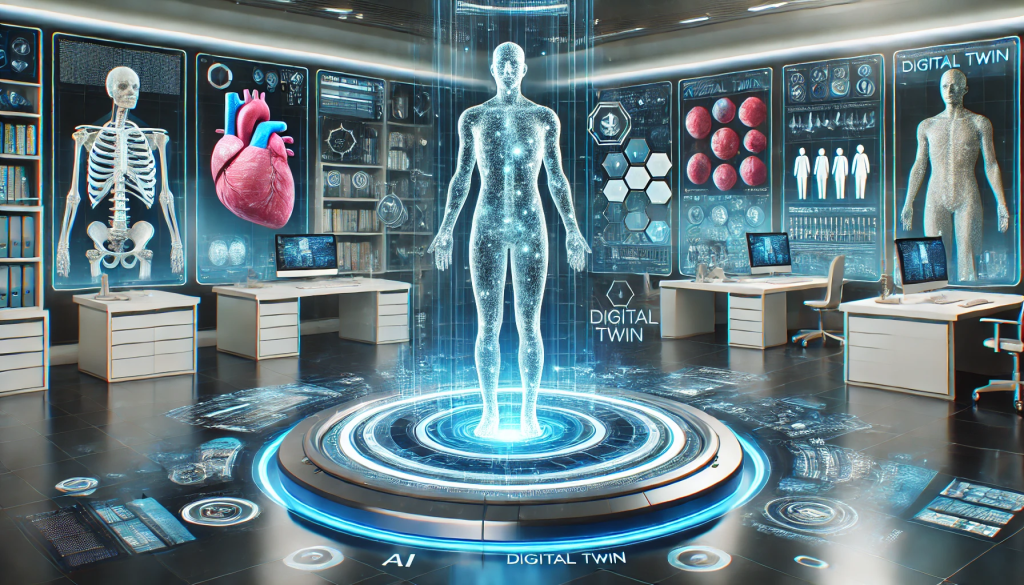
Understanding Digital Twins
At its core, a digital twin is a virtual representation of a physical entity—which, in healthcare, can range from an individual patient to a specific organ, a cellular process, or even an entire hospital system. Unlike static medical models, digital twins continuously update in response to real-time data streams, allowing researchers and physicians to test different scenarios before making clinical decisions.
In cardiology, for example, personalized heart digital twins are being developed to simulate electrophysiological activity, hemodynamics, and structural changes. At Johns Hopkins University, researchers have created digital replicas of patients’ hearts using a combination of MRI scans, ECG readings, and genetic markers. These models could allow specialists to predict arrhythmias, optimize ablation procedures, and tailor drug therapy for conditions like atrial fibrillation. By refining treatment strategies in a virtual environment before applying them to a real patient, we can move to digital trial-and-error and improve clinical outcomes with less risk of harming patients.
Beyond individual patient care, digital twins are also proving useful at the healthcare system level, where they are being deployed to optimize hospital workflows, predict ICU bed occupancy, and enhance resource allocation (we learned how important these processes are during the pandemic). Hospitals can use digital twin technology to analyze patient flow in emergency departments, simulate staffing needs, and identify bottlenecks in care delivery—all in real-time.
How Are Digital Twins Created and Simulated?
Building a functional digital twin is a multistep process requiring the integration of diverse data sources, computational modeling techniques, and real-time feedback loops. The first step in this process involves data acquisition, which relies on multimodal inputs such as clinical health records, imaging data, genetic information, physiological monitoring, and lifestyle factors. Wearable devices, including smartwatches and implantable cardiac monitors, further enrich digital twin models by providing continuous physiological data that reflects changes in a patient’s condition over time.
Once sufficient data has been collected, computational models are constructed to replicate the structure and function of the target system. The choice of modeling technique depends on the complexity of the biological system being simulated.
- Finite Element Modeling: Used for simulating tissue mechanics (e.g., in orthopedic or cardiac applications).
- Agent-Based Models: Simulating complex systems like immune response or cancer progression.
- Machine Learning and Deep Learning Models: Analyzing vast data sets for personalized diagnostics and treatment optimization.
- Physics-Based Simulations: Used for modeling blood flow, drug diffusion, and electrophysiologic properties.
The final stage of digital twin development involves continuous updating and real-time simulation. This is achieved by integrating live data streams, allowing the model to evolve dynamically in response to new inputs. For example, a diabetes digital twin might use continuous glucose monitor readings to predict blood sugar fluctuations and adjust insulin recommendations accordingly. Similarly, a digital twin of the respiratory system could monitor a COPD patient’s oxygen saturation levels and predict exacerbations before they occur, enabling preemptive interventions.
Applications of Digital Twins in Healthcare
Personalized Medicine and Predictive Healthcare
Digital twins have the potential to revolutionize personalized treatment strategies, allowing clinicians to tailor interventions to a patient’s unique biological and physiological profile. In oncology, for example, digital twin models can simulate tumor growth dynamics and predict how an individual will respond to different chemotherapy regimens before initiating treatment. Similarly, in cardiology, digital twin simulations can optimize pacemaker settings based on cardiac electrophysiology data, estimating the maximum benefit from potential therapy adjustments.
Drug Discovery and Development
One of the biggest challenges in pharmaceutical research is the lengthy and expensive process of drug discovery, with many compounds failing in late-stage trials. Digital twins are revolutionizing drug development by simulating drug interactions at the molecular level, allowing researchers to test thousands of compounds in silico before advancing to preclinical trials. By creating digital twins of human cells and organs, scientists can predict how a new drug will interact with different biological pathways, helping identify promising candidates while eliminating those likely to cause adverse effects. This reduces reliance on traditional animal testing and significantly accelerates the early-stage research process. For instance, AI-driven virtual liver models are being used to assess drug toxicity before human trials, helping pharmaceutical companies detect hepatotoxic side effects much earlier in development.
Digital Twins in Clinical Trials
Traditional clinical trials face significant challenges, including high costs, lengthy durations, and difficulties in patient recruitment. Digital twins offer a transformative solution by enabling virtual clinical trials, where thousands of synthetic patient models can be used to simulate treatment responses before real-world trials begin. Virtual trials allow researchers to identify early biomarkers of drug efficacy, optimize drug dosages before enrolling human participants, and predict which patient subgroups will benefit most, thereby enabling more efficient and targeted trial designs.
Regulatory agencies, including the FDA and EMA, are now beginning to accept digital twin models as supplementary evidence in drug approval processes. This trend is expected to accelerate the adoption of AI-driven clinical trial methodologies, ultimately reducing the time it takes to bring life-saving drugs to market.
Healthcare System Optimization
At a macro level, digital twins are transforming hospital and healthcare system operations. By modeling patient flow in emergency departments, digital twins help administrators optimize bed occupancy, staffing levels, and resource allocation. During the COVID-19 pandemic, hospitals leveraging digital twin technology were able to predict ICU surges weeks in advance, allowing them to proactively adjust ventilator distribution and staffing to meet demand.
The Future of Digital Twins in Medicine
As AI, cloud computing, and biomedical engineering continue to evolve, the role of digital twins in healthcare will expand dramatically. Future advancements will likely integrate multi-scale modeling, where molecular-level simulations are combined with full-body models to provide an even more detailed understanding of disease processes. AI-driven real-time predictive analytics will further enhance the ability of digital twins to anticipate health crises before they manifest, enabling truly proactive medicine.
However, several challenges remain. Data privacy and security concerns must be addressed to ensure that sensitive patient information is protected from cyber threats. Additionally, computational complexity remains a significant hurdle, as running real-time simulations on large datasets requires immense processing power. Regulatory frameworks also need to evolve to incorporate digital twins into clinical decision-making and FDA-approved treatment protocols.
Despite these challenges, digital twins represent one of the most exciting frontiers in healthcare innovation. By bridging the gap between AI, biomedical engineering, and clinical practice, they have the potential to redefine how diseases are diagnosed, treated, and managed, ushering in a new era of truly personalized and predictive medicine.
For further reading and a deep dive on digital twins in healthcare, please see this scoping review by Katsoulakis et al in Nature: Digital Medicine.
Please subscribe to our Newsletter for email notifications containing new posts as soon as they are published:

 Cardio Cypher