
Google has rapidly become a major player in the healthcare AI space, developing a suite of tools with the potential to revolutionize everything from drug discovery to patient care. This post explores some of Google’s key AI initiatives in healthcare, with a particular focus on the powerful foundation models driving these advancements.
Foundation Models: The Core of Google’s Healthcare AI
Foundation models, trained on massive and diverse datasets, are the backbone of many of Google’s healthcare AI applications. Their ability to perform a wide range of tasks, from natural language processing to image analysis, makes them invaluable building blocks for specialized healthcare tools. They have already iterated through a few versions of these.
Med-PaLM:
This large language model (LLM) is specifically fine-tuned for the medical domain. Trained on a vast corpus of medical text and code, Med-PaLM has demonstrated impressive capabilities in several key areas.
- Medical Question Answering: Med-PaLM can answer complex medical questions, often with accuracy comparable to human experts. While not a replacement for physician expertise, this capability holds promise for creating AI-powered medical assistants and knowledge resources. For example, it can answer questions about treatment options for specific conditions, interpret medical terminology, and summarize research findings. However, it’s crucial to note that Med-PaLM, like other LLMs, can sometimes generate incorrect or misleading information (a phenomenon known as “hallucination”), highlighting the need for careful validation and oversight.
- Medical Text Summarization: Med-PaLM can condense lengthy medical documents, such as research papers or patient records, into concise summaries. This can save clinicians valuable time and effort, allowing them to quickly grasp the key information from complex texts.
- Medical Report Generation: In some cases, Med-PaLM has shown the ability to generate medical reports from patient data. While still in early stages of development, this capability could potentially streamline documentation processes and improve efficiency.
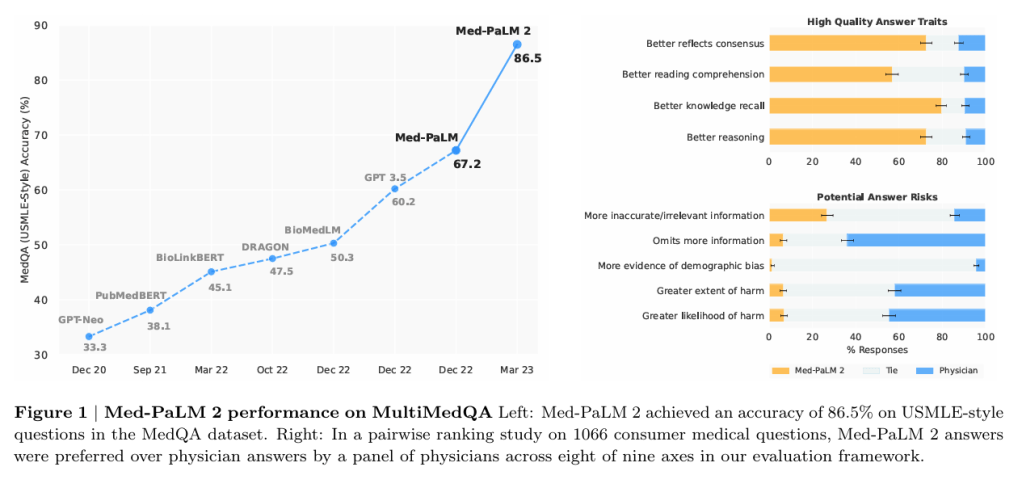
Med-PaLM 2:
Building upon the success of its predecessor, Med-PaLM 2 represents a significant advancement in medical AI. It boasts improved performance across a range of tasks.
- Enhanced Reasoning Abilities: Med-PaLM 2 exhibits more robust reasoning capabilities, allowing it to better handle complex medical scenarios and integrate information from multiple sources.
- Improved Accuracy: Extensive evaluations have demonstrated increased accuracy in medical question answering and other tasks compared to Med-PaLM.
Med-PaLM M:
Medicine demands the simultaneous interpretation and integration of diverse data types, including text, images, genomics, and more, creating unique challenges. This iteration of Med-PaLM is designed specifically for multimodal medical applications. It can analyze medical images, such as X-rays and CT scans, in conjunction with text data, like patient history, enabling a more holistic functionality. By leveraging these diverse capabilities, it can enhance diagnosis, personalize treatment plans, accelerate medical research, improve communication among healthcare providers, and ultimately enhance the quality and efficiency of patient care. This includes applications in radiology, pathology, oncology, and drug discovery. However, continued development, addressing challenges like data privacy and bias, and ensuring responsible implementation are crucial for realizing the full potential of Med-PaLM M in transforming healthcare. There is an excellent research paper discussing these advances that was published in an early edition of the NEJM AI: Towards Generalist Biomedical AI. The paper also reviews the creation of MultiMedBench, which is an advanced biomedical benchmark used to assess and aid in model development.
Watch an overview of Med-PaLM from Google Health:
Beyond Foundation Models: AlphaFold and Protein Structure Prediction
AlphaFold:
AlphaFold is a groundbreaking AI system developed by Google DeepMind that predicts the 3D structure of proteins from their amino acid sequences. This is a critical task because protein structure determines its function. AlphaFold achieves unprecedented accuracy in these predictions, revolutionizing our understanding of biological processes.
While both AlphaFold and LLMs leverage deep learning, they differ significantly in their purpose and functionality. LLMs, like Med-PaLM, are designed to process and generate human language, engaging in tasks such as understanding and generating text, translating languages, and answering questions. In contrast, AlphaFold is specifically designed for a highly specialized task: predicting the 3D structure of proteins from their amino acid sequences. It focuses on complex biological information and uses sophisticated algorithms to predict the intricate shapes of proteins, a fundamental task for understanding biological processes and developing new medicines. It has several functionalities:
- Accurate Protein Folding Prediction: AlphaFold can accurately predict the 3D structure of proteins from their amino acid sequence. This is a major breakthrough because protein structure is crucial for understanding protein function and developing targeted therapies.
- Impact on Drug Discovery: By accelerating the process of protein structure determination, AlphaFold is significantly impacting drug discovery efforts. Researchers can now use AlphaFold to identify potential drug targets and design novel therapies more efficiently.
- Understanding Disease Mechanisms: AlphaFold is also helping researchers understand the mechanisms of disease by providing insights into the structure and function of proteins involved in various disease processes.
- Open Access and Collaboration: The open-source availability of AlphaFold has fostered collaboration and accelerated research in numerous fields, from drug discovery to materials science. The DeepMind website provides information and access to AlphaFold resources.
AlphaFold was trained on a massive dataset of protein structures and sequences, primarily from the Protein Data Bank. The training process involved supervised learning using known protein structures and sequences, followed by self-supervised learning where the model predicted structures for sequences without known structures and then used these predictions to further enhance its training. Key to its success were attention mechanisms (similar to those found in transformer models), which allowed the model to focus on relevant parts of the protein sequence, and the utilization of significant computational resources.
Applications in Healthcare: AI-Powered Diagnostics and Treatment
Many of these tools and other models developed by Google have been used in active medical research by partnering with physicians and hospital systems to make advances in patient care.
- AI-powered Pathology: Google has been exploring the use of AI to assist pathologists in analyzing tissue samples, identifying cancerous cells, and predicting patient outcomes. These tools can potentially improve diagnostic accuracy, reduce pathologist workload, and personalize treatment plans. Ongoing research focuses on developing robust algorithms that can generalize across different staining techniques and tissue types, as well as integrating AI tools seamlessly into existing pathology workflows.
- Medical Imaging: AI is being applied to analyze medical images, such as X-rays, CT scans, and MRIs, to detect anomalies, assist in diagnosis, and monitor disease progression. For example, Google has developed AI models for detecting diabetic retinopathy, a leading cause of blindness, from retinal images. These tools can improve access to screening, particularly in underserved areas, and enhance the efficiency of image interpretation. Further research is exploring the use of AI for early detection of other conditions, such as lung cancer and cardiovascular disease.
- Drug Discovery and Development: Building on the AlphaFold breakthrough, Google DeepMind and Isomorphic Labs are leveraging AI to accelerate drug discovery by analyzing vast datasets of molecular information, predicting drug efficacy and safety, and optimizing drug design. These efforts aim to reduce the time and cost associated with bringing new drugs to market. Challenges in this area include the complexity of biological systems and the need for large, high-quality datasets. NOTE: Isomorphic Labs is an AI-driven drug discovery company founded by Demis Hassabis, the CEO of Google DeepMind, and is a subsidiary of Alphabet.
Challenges and Considerations
While the potential of AI in healthcare is immense, several challenges must be addressed to ensure its responsible and effective implementation.
- Data Privacy and Security: Protecting patient data is paramount. Robust security measures and compliance with regulations like HIPAA are crucial for building trust and ensuring ethical use of AI in healthcare. Federated learning, which allows models to be trained on decentralized datasets without sharing sensitive information, is a promising approach to address privacy concerns.
- Bias and Fairness: AI models can inherit biases present in the data they are trained on, potentially leading to disparities in care. Careful attention must be paid to data diversity and algorithm design to mitigate bias and ensure fairness. Explainability is crucial for identifying and addressing potential biases in AI-driven decisions.
- Explainability and Transparency: Understanding how an AI model arrives at a particular conclusion is essential for building trust and ensuring accountability. Research in explainable AI (XAI) is crucial for making AI-driven decisions more transparent and interpretable to clinicians and patients.
- Integration into Clinical Workflows: Seamless integration of AI tools into existing clinical workflows is essential for their adoption and effectiveness. This requires careful consideration of user interface design, interoperability with existing systems, and training for healthcare professionals.
- Regulatory and Ethical Considerations: Clear regulatory frameworks and ethical guidelines are needed to govern the development and deployment of AI in healthcare. This includes addressing issues such as liability, accountability, and patient consent.
Google and The Future of AI in Healthcare
Google’s AI initiatives in healthcare represent a significant investment in the future of medicine. While challenges remain, the potential benefits are enormous. As these technologies mature, we can expect to see more AI-powered tools that improve diagnostics, personalize treatment, accelerate drug discovery, and ultimately enhance patient care. The collaboration between technical experts and medical professionals will be critical to realizing the full potential of AI in healthcare and ensuring its responsible and ethical implementation. Continued research, rigorous validation, and open dialogue are essential for navigating the complex landscape of AI in medicine and shaping a future where AI empowers both clinicians and patients. It is exciting to see a company like Google dedicated to advancing this mission.
Please subscribe to our Newsletter for email notifications containing new posts as soon as they are published:

 Cardio Cypher