
A physician’s exploration of how wearable technology and biomarker testing are changing our understanding of cardiovascular fitness, recovery, and endurance performance.
I have always been a relatively active person, intermittently training for various amateur events and races. I never thought much about my training data even though I have always had some form of activity tracker. Then a perforated appendix, four-day hospitalization, and the predictable period of inactivity that followed abruptly changed my physiology.
My Apple Watch alerted me to all the changes. My training volume collapsed. My resting heart rate increased, heart-rate variability declined, and all the general fitness estimates moved in the wrong direction. When I finally began exercising again, familiar efforts were much more difficult, and it was a struggle to get back to my previous level.
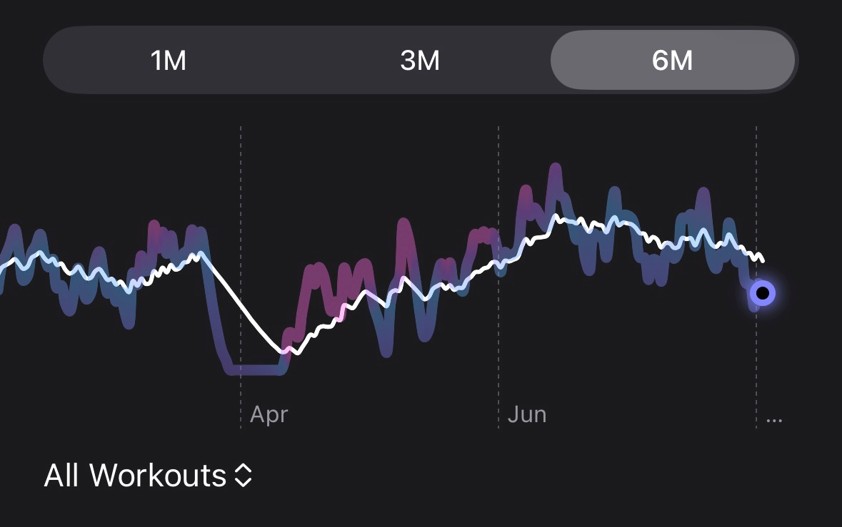
None of this was surprising. What was more interesting was the opportunity it created.
Recovery gave me a natural experiment: How accurately could the measurements I already collect describe the loss and return of cardiovascular fitness? Would VO₂ max, resting heart rate, heart-rate variability, power, pace, and subjective effort improve together and at the same rate or would they tell different stories?
As a cardiologist and amateur triathlete, I approach these questions from two perspectives. Clinically, I enjoy understanding the physiology behind the measurements and their limitations. As an amateur athlete, with limited time to train, I also understand the temptation to compress a complex biological system into a single score and how easily one can be overwhelmed by the many variables available to them on most fitness trackers.
I decided to create a personal experiment. I set a goal for completing the Ironman 70.3 race in Frankfort, MI on September 22. While training, I will attempt to measure my fitness systematically while describing my recovery from illness and race preparation.
I will combine data from WHOOP, Apple (Apple Watch Ultra 2), Strava, and physiological testing through a partnership with VO Health. The goal is not to prove that one device or measurement is “correct.” It is to determine what each metric can tell us, what it cannot, and whether combining them produces a more useful picture of adaptation and performance.
Fitness as a Multi-Variable System
Cardiorespiratory fitness is among the strongest markers of long-term health. The American Heart Association has argued that it should be treated as a clinical vital sign because of its close relationship with cardiovascular outcomes and mortality. Yet fitness is not measured routinely in most clinical settings, and when it is discussed outside the laboratory, it is often reduced to an estimated VO₂ max displayed on a wearable.
VO₂ max represents the highest rate at which the body can take in, transport, and use oxygen during intense exercise. It integrates pulmonary gas exchange, cardiac output, oxygen-carrying capacity, peripheral blood flow, and skeletal-muscle oxygen extraction. That makes it an unusually informative measurement but not a complete description of performance.
Two athletes with the same VO₂ max may perform very differently. One may be able to sustain a larger percentage of that capacity near the lactate or ventilatory threshold. Another may have better movement economy and therefore require less oxygen to produce the same pace or power. Training durability, fueling, thermoregulation, biomechanics, and psychology also influence what happens during a long race.
VO₂ max describes the size of the aerobic engine. It does not, by itself, tell us how efficiently that engine operates or how much of its capacity can be sustained.
Beyond VO2 Max
Wearable devices and biochemistry produce far more physiologic data than VO₂ max alone. The challenge is deciding which signals deserve attention and when.
Resting heart rate is simple, accessible, and often directionally useful. Endurance training commonly lowers resting and submaximal heart rate through changes in autonomic tone, stroke volume, and cardiovascular efficiency. But resting heart rate is also affected by sleep, hydration, temperature, illness, medications, alcohol, and emotional stress. A single elevated value rarely means much. A sustained change from an established baseline may.
Heart-rate variability, or HRV, describes beat-to-beat variation in cardiac cycle length. It is influenced substantially by autonomic nervous system activity and is commonly used as a marker of physiological strain; it is a big driver of the WHOOP recovery score for instance. However, HRV is highly individual and sensitive to measurement conditions. The meaningful comparison is generally not my HRV against someone else’s, but my recent trend against my own baseline. Even then, interpretation requires context. A lower value can accompany illness, poor sleep, heavy training, psychological stress, or inadequate recovery. A higher value is not automatically better, and a single morning measurement should not necessarily determine an entire day’s training plan.
Pace and power are measures of external performance. They tell us about the work we produced. Heart rate, perceived exertion, and metabolic measurements describe aspects of the internal cost of producing it. When the same cycling power requires a higher heart rate and greater perceived effort than it did previously, that discrepancy may reveal something important even if a wearable fitness score has barely changed.
This distinction between external workload and internal physiological response is central to athlete monitoring. No isolated metric reliably captures training load, recovery, and adaptation. The value comes from evaluating several measurements together, following their trajectories over time, and knowing what this means for your individual fitness and training program.
Lessons from Acute Illness
Before my hospitalization at the end of March, I didn’t pay close attention to my training and recovery data. During my illness, several of those patterns changed at once and caught my attention.
My weight decreased from approximately 150 lbs to 140 lbs. Weekly training volume fell from 6-10 hrs to essentially zero. Resting heart rate increased from approximately 55 bpm to 67 bpm, while HRV declined from 72 ms to 35 ms. My wearable-estimated VO₂ max dropped from 43 to 30. My watch automatically alerted me to many of these.
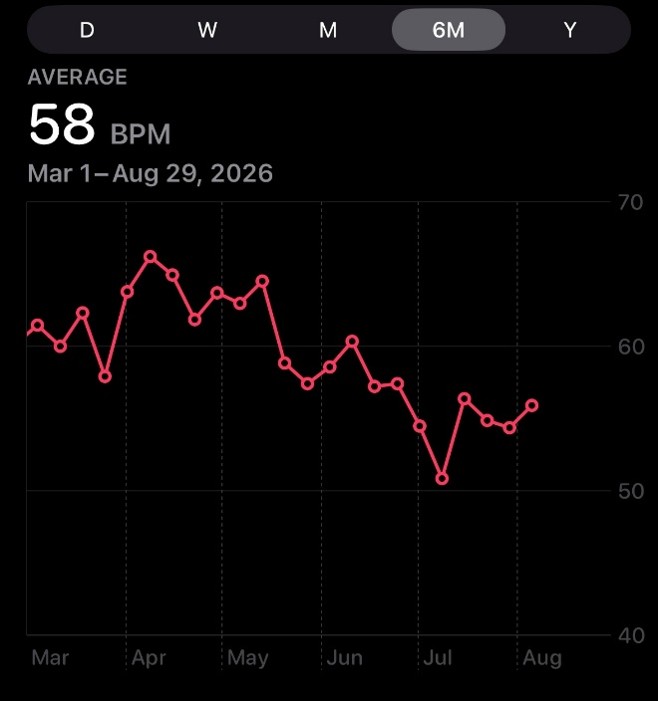
The first workouts back provided more evidence that something had changed. At a pace or power that previously felt routine, my heart rate was higher and my perceived exertion was greater. The number on the watch could identify part of the decline, but the relationship between workload and physiological response made the loss of fitness more tangible.
This is why longitudinal data are more useful than isolated measurements. A resting heart rate of 60 beats per minute may be normal for one person and meaningfully elevated for another. A HRV value that looks low in comparison with a population average may be entirely typical for an individual. Even VO₂ max depends on the method of measurement, the exercise modality, the protocol, and whether it is measured directly or estimated.
The signal often lies in the pattern, not just the number.
The BioTech Stack
This project will combine four complementary sources of information: WHOOP, Apple Health, Strava, and laboratory testing through VO Health.
Each occupies a different layer of the measurement system.
WHOOP: Quantifying Systemic Strain and Recovery
WHOOP provides longitudinal recovery data, including resting heart rate, HRV, sleep, VO₂ max estimates and its proprietary algorithms measuring strain and recovery.
I am less interested in any single daily recovery score than in how its underlying measurements change with training load, illness, sleep, and mental health. A red, yellow, or green score is easy to understand, but it is still a simplified interpretation of multiple inputs. I want to examine the measurements beneath the score and determine whether they consistently correspond with how I feel and perform.
Apple Health: Tracking Longitudinal Cardiovascular Signals
Apple Watch will provide heart rate during exercise, resting and walking heart rate, workout tracking, and Apple’s Cardio Fitness level (VO₂ max estimate). Apple Health will serve as a central repository for reviewing how several of these measurements evolve over time.
The Apple Cardio Fitness estimate is particularly interesting because it attempts to infer cardiorespiratory fitness during submaximal activity rather than requiring an all-out effort. That convenience makes longitudinal monitoring possible, but it also introduces assumptions about the relationship between heart rate, pace, workload, and aerobic capacity that we will explore later in the series.
Strava: Measuring External Workload and Output
Strava will provide the performance layer. Pace, power, duration, and comparisons across familiar routes or efforts can show what outputs I produced during training.
This data becomes more meaningful when paired with the internal physiological cost of the effort. Completing the same route at the same pace is not physiologically equivalent if it requires a substantially higher heart rate or perceived effort. Conversely, an improvement in pace or power at the same heart rate may signal adaptation even before a wearable’s fitness estimate changes.
VO Health: Profiling Biomarkers and Functional Capacity
I have partnered with VO Health to help track changes in selected biomarkers during this project. VO Health lab panels utilize advanced multi-omic biomarker profiling to evaluate systemic cardiovascular, metabolic, hormonal, and inflammatory health beyond standard clinical reference. These molecular signatures have been engineered to track biological strain, recovery, and cellular adaptation over time. They have adapted their proprietary algorithms to a point where they can estimate VO₂ max from the blood proteome. I will complete their propriety panel of fitness biomarkers three times throughout the project and explore what these results add to standard physiologic measurements. We will discuss these biomarkers in much greater detail later in the series.
In addition, their expert exercise physiologists have helped me develop practical fitness testing protocols that can be completed outside of a conventional exercise laboratory and will be repeated throughout the project:
- Functional threshold power (FTP) testing
- Critical-power time trials
- Power-ramp testing (practical proxy for changes in VO₂ max)
The distinction between measurement and estimation will be important. A laboratory VO₂ measurement, a wearable-generated VO₂ estimate, and performance on a Peloton ramp test are different and not necessarily interchangeable. They examine related aspects of fitness using different inputs and assumptions. It will be interesting which measures track more to my subjective fitness experience.
If performance on the ramp test improves alongside estimated VO₂ max, FTP, and submaximal exercise efficiency, it may prove useful as a practical proxy for tracking change. If the measurements diverge, that may be equally informative.
Structuring the Training Experiment
This will be an N-of-1 investigation rather than a formal validation study. It is a structured examination of how different tools characterize the same process of illness, recovery, and adaptation.
Over the coming months, I will use the tools above to follow several connected domains:
- Laboratory-measured and wearable-estimated VO₂ max
- Resting heart rate and HRV
- Cycling FTP, critical power and pace
- Heart rate at standardized submaximal workloads
- Performance on a repeatable cycling power ramp test
- Training volume and intensity distribution
- Sleep, recovery, and perceived exertion
- Selected biomarkers measured through VO Health
- Real-world performance during training and competition
Where possible, I will standardize the conditions under which I perform key tests. That includes the equipment used, time of day, fueling, recent training, and the structure of the test itself. Perfect standardization will not be possible in real life, but reducing avoidable variability should make the trends easier to interpret.
I will also document factors that could distort the data, including illness, disrupted sleep, travel, environmental conditions, and changes in training volume.
My schedule will remain intentionally realistic. I am not training as a professional athlete. I am training around my clinical work and family responsibilities, usually with about one hour available per weekday with slightly more on the weekends.
That constraint is part of the experiment rather than an obstacle to it. Most people interested in improving their fitness are working within similar limitations. A testing strategy that requires extensive laboratory access or frequent maximal efforts may be scientifically interesting but impractical for routine use.
The objective is to determine which measurements are actionable. If a metric changes but does not alter how I train, recover, or understand performance, its practical value may be limited. Conversely, a relatively simple measurement may be valuable if it routinely identifies fatigue, confirms adaptation, or helps distinguish a temporary setback from a true change in fitness.
Anticipating What the Physiological Signals Will Reveal
Several outcomes are possible.
The different measurements may move together. Laboratory VO₂ max, wearable estimates, critical power, ramp-test performance, resting heart rate, and submaximal exercise efficiency may all improve in parallel as training consistency increases.
They may also improve at different rates.
Resting heart rate and HRV could level off before maximal performance does. FTP might increase without a meaningful change in VO₂ max because of improvements in threshold, efficiency, or tolerance of sustained work. A wearable estimate could remain unchanged despite clear improvement in power at a standardized heart rate. Biomarker changes may or may not correspond with other recovery or performance measurements.
These discrepancies should not automatically be treated as measurement failures. They may demonstrate that the tools are capturing different components of adaptation.
The most useful measurement may also depend on the question being asked. Laboratory testing may provide the best characterization of physiology. Power and pace may provide the clearest evidence of performance. HRV and resting heart rate may be more responsive to short-term stress and recovery. A standardized ramp test may be less comprehensive than laboratory testing but far easier to repeat.
Every measurement contains biological variation, technical error, and assumptions about what is being represented. Proprietary scores add another interpretive layer that is not always transparent.
The appropriate response is not to dismiss the data. It is to interpret them within their known limitations, which I hope to learn more about. For an amateur athlete, the most useful system will probably not be the one that produces the largest number of measurements. It will be the one that connects a small number of reliable signals to specific decisions:
- Should I complete the planned workout?
- Is my current training producing results?
- Has my performance improved, or have I simply become better at a particular test?
- Am I carrying transient fatigue, or has my underlying fitness changed?
- Do laboratory measurements confirm what my wearable devices appear to show?
My recovery after illness offers a useful place to start. I know that my fitness declined. I can observe that it is returning. The more interesting question is which measurements describe that process faithfully, and which merely create the appearance of precision.
Over the course of this series, we will learn a lot about exercise physiology, wearable fitness measurements and biomarker tracking. I invite anyone interested in learning more to follow along. I will be making a series of posts every two weeks while training for the Frankfort Ironman 70.3. All posts will be shared on CardioCypher.com (you can sign up for email notifications about new posts, or just check back periodically). You can also sign-up for This Week in Cardiovascular AI, a separate newsletter that comes out on a bi-weekly basis and will contain updates on the project.
Also, if you’re interested in VO Health’s biomarker profiling, you can sign up for their beta testing waitlist here: https://vohealth.co/waitlist.
Join the journey and sign-up to be notified when new posts are live:


