
I currently have several different answers to a basic question:
What is my VO₂ max?
My Apple Watch generates a Cardio Fitness estimate from selected outdoor workouts. WHOOP provides its own estimate. VO Health uses a blood-based proteomic model to characterize cardiovascular fitness. A Peloton ramp test measures how far I can progress through increasing power demands, while functional threshold power and critical-power testing describe other aspects of cycling performance.
These values are related, but they measure different things. The wearables and blood test estimate aerobic fitness from indirect signals. The cycling tests measure performance under specific conditions.
This distinction matters for the experiment I introduced in my previous post. After a hospitalization and prolonged interruption in training, my Apple Watch–estimated VO₂ max fell from approximately 43 to 30 mL/kg/min. As I resumed training, the estimate began to recover. My resting heart rate, HRV, pace, power, and subjective exercise tolerance also improved.
I want to know whether these measurements track the same recovery process, and which ones provide information I can actually use to guide training.
What VO₂ Max Actually Measures
VO₂ max is the highest rate at which the body can take in, transport, and use oxygen during intense exercise. Its physiology can be derived from the Fick equation:
VO₂ = cardiac output × arteriovenous oxygen difference
The cardiovascular system must deliver oxygen to the exercising muscles, and those muscles must extract and use it. The result depends on pulmonary gas exchange, hemoglobin, blood volume, heart rate, stroke volume, peripheral blood flow, capillary density, mitochondrial function, and muscle characteristics. VO₂ max integrates the performance of this entire system.
Cardiorespiratory fitness is strongly associated with cardiovascular risk, functional capacity, and long-term health. The American Heart Association has proposed treating it as a clinical vital sign because it adds prognostic information beyond many traditional risk factors.
Direct Measurement versus Estimation
The reference method for measuring VO₂ max is cardiopulmonary exercise testing, or CPET. During a progressively harder treadmill or cycling test, a metabolic analyzer measures oxygen uptake and carbon dioxide production from expired air. A classic VO₂ max occurs when oxygen consumption plateaus despite a further increase in workload, although a clear plateau is not always seen. Exercise physiologists may therefore also consider peak oxygen uptake, respiratory exchange ratio, heart rate, perceived exertion, and sometimes a verification effort.
The result can still vary with exercise modality, protocol, equipment familiarity, fatigue, motivation, environmental conditions, and calibration. A cyclist may produce a different value on a treadmill than on a bicycle. Relative VO₂ max can also change with body weight even when absolute oxygen consumption is unchanged. This is relevant in my case because my illness was followed by a roughly 10-pound weight loss.
CPET is the best physiological reference, but the number still has to be interpreted in context.
How Apple and WHOOP Estimate Aerobic Fitness
An Apple Watch does not measure oxygen consumption. Instead, it uses a submaximal prediction model during qualifying outdoor walks, runs, and hikes. The watch evaluates the relationship between heart rate and physical activity using heart, motion, GPS, and other sensor data, then extrapolates toward estimated maximal aerobic capacity. The wearer needs to reach a sufficient level of exertion, but not maximal effort.
At a given pace and terrain, a more aerobically fit person will generally perform the work with a lower relative cardiovascular demand. However, heart rate at a given workload also changes with heat, dehydration, sleep, illness, stress, caffeine, medications, cardiac drift, sensor error, and terrain. Each of these factors can affect the estimate without representing a true change in aerobic capacity.
WHOOP uses a three-tier proprietary approach. Depending on the data available, its estimate can incorporate recovery physiology, activity data, demographic information, GPS-enabled running, and laboratory testing. Apple’s model is more specifically tied to heart rate and movement during qualifying outdoor workouts.
Much of my training occurs on a Peloton, outdoor bicycle, or in a pool, none of which generates an Apple Cardio Fitness estimate. Apple therefore sees only part of my training. Both platforms also rely on proprietary algorithms, so I cannot independently reconstruct how each input contributes to the final value.
Wearable estimates can perform reasonably well across populations while still being meaningfully wrong for an individual. For this experiment, I care about two separate questions: how close each estimate is to CPET and how reliably it tracks change. A watch that reads 42 when CPET measures 47 could still be useful if it consistently detects improvement or decline. A single close match would be less helpful if the estimate does not respond to training.
Can a Blood Test Estimate VO₂ Max?
VO Health adds a different type of measurement to this experiment. Its multi-omic biomarker profiling includes a proteomic estimate of VO₂ max derived from patterns of circulating proteins associated with cardiorespiratory fitness.
The blood test does not measure oxygen consumption during exercise. It identifies a molecular pattern associated with fitness that may reflect cardiovascular function, metabolism, inflammation, skeletal muscle, and systemic adaptation. Its validity depends on the population used to build the model, the quality of the reference testing, the stability of the biomarkers, and whether the relationship holds within one person over time.
I plan to repeat the biomarker panel three times during training and compare it with wearable estimates, power, standardized field testing, and subjective exercise tolerance. I am interested in whether the initial value agrees with the other estimates, but the more useful result will be whether it changes alongside measurable improvements in fitness and performance.
Performance Tests Answer Different Questions
Working with exercise physiologists at VO Health, I developed a set of repeatable tests that can be performed outside a conventional laboratory. These tests do not directly measure VO₂ max, but they may be more useful for specific training decisions:
Peloton ramp test: Power rises progressively until I can no longer maintain the required workload. Peak power reflects aerobic capacity, anaerobic contribution, neuromuscular capacity, cadence, motivation, and protocol design. I can repeat the same test on the same bicycle, which makes it a practical way to follow change.
Functional threshold power: FTP estimates the highest cycling power that can be sustained for approximately one hour, usually from a shorter test. It reflects threshold physiology, cycling economy, muscular endurance, pacing, and fatigue tolerance. This may be more actionable for a half-Ironman because the bike leg depends on how much power I can sustain without compromising the run.
Critical power: Critical power is derived from maximal efforts of different durations and estimates the boundary between sustainable exercise and more severe work in which fatigue progressively accumulates. The model also yields W′, the finite amount of work that can be performed above critical power. An increase in critical power without a change in VO₂ max would suggest that I can sustain a greater proportion of my aerobic capacity.
Each test can also be entered into an equation that estimates VO₂ max. These calculated values depend on the performance test, the prediction equation, and how closely I resemble the population in which that equation was developed.
Establishing My Baseline
At a body weight of approximately 150 pounds, I compared five estimates derived from my wearables and cycling tests. None directly measured respiratory gas exchange. The estimates ranged from 42 to 62 mL/kg/min:
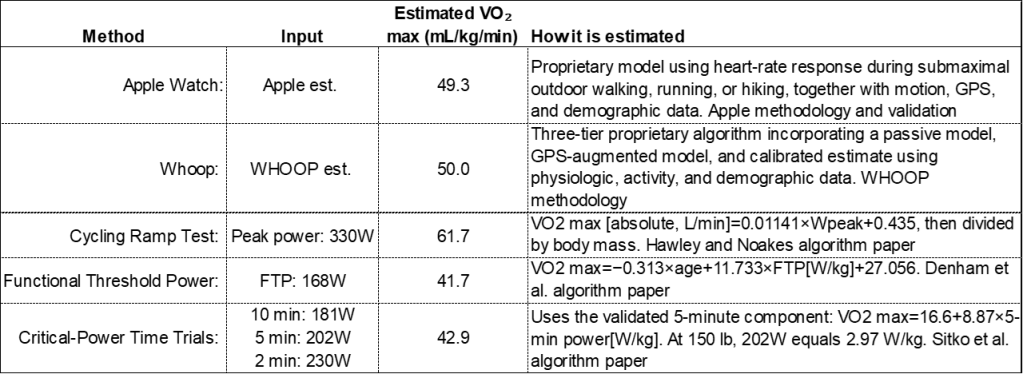
The margin reflects differences in both the tests and the equations used to convert them into VO₂ max. Apple and WHOOP infer aerobic fitness from physiological and activity data. The ramp test includes a larger contribution from short-duration maximal capacity. FTP and critical-power efforts emphasize sustained power, threshold physiology, cycling economy, muscular endurance, and pacing.
My ramp result suggests relatively strong short-duration maximal capacity. The lower FTP- and critical-power-derived estimates suggest that my ability to sustain a high proportion of that capacity may still be developing. Apple and WHOOP fall between those values and agree closely with each other, although that does not establish that either is correct.
I plan to obtain direct CPET as a physiological reference. I will then repeat these tests during training to see which measurements detect improvement and which ones are most useful for preparing for an endurance race.
The Measurement Must Match the Question
VO₂ max is an important physiological measurement and a powerful marker of health. It is less useful when it is treated as a complete description of fitness or performance.
It describes maximal aerobic capacity. It does not tell me whether I am ready for today’s workout, how much power I can sustain during a half-Ironman bike leg, whether I am adequately fueled, or how I will tolerate several hours of accumulated fatigue.
Direct gas-exchange testing is the reference for aerobic physiology. Wearables are more practical for frequent monitoring. FTP and critical power are more actionable for prescribing cycling intensity. Biomarkers may provide additional information about systemic adaptation. I do not expect any one measurement to answer all of these questions.
The goal of this experiment is to determine which measurements are accurate, repeatable, and useful enough to improve my training in the real world.
Stay tuned!
Selected References:
- Ross R, Blair SN, Arena R, et al. Importance of assessing cardiorespiratory fitness in clinical practice: A case for fitness as a clinical vital sign. Circulation. 2016;134(24):e653-e699. doi:10.1161/CIR.0000000000000461.
- Poole DC, Jones AM. Measurement of the maximum oxygen uptake: VO₂peak is no longer acceptable. J Appl Physiol. 2017;122(4):997-1002. doi:10.1152/japplphysiol.01063.2016.
- Molina-Garcia P, Notbohm HL, Schumann M, et al. Validity of estimating the maximal oxygen consumption by consumer wearables: A systematic review with meta-analysis and expert statement of the INTERLIVE Network. Sports Med. 2022;52(7):1577-1597. doi:10.1007/s40279-021-01639-y.
- Apple Inc. Using Apple Watch to Estimate Cardio Fitness With VO₂ Max. May 2021. Apple white paper.
- Apple Inc. Track Your Cardio Fitness Levels. Updated October 27, 2025. Apple Support.
- WHOOP. VO₂ Max Estimate With WHOOP: Accuracy, Trends, and More. May 29, 2026. WHOOP methodology.
- Hawley JA, Noakes TD. Peak power output predicts maximal oxygen uptake and performance time in trained cyclists. Eur J Appl Physiol Occup Physiol. 1992;65(1):79-83. doi:10.1007/BF01466278.
- Denham J, Scott-Hamilton J, Hagstrom AD, Gray AJ. Cycling power outputs predict functional threshold power and maximum oxygen uptake. J Strength Cond Res. 2020;34(12):3489-3497. doi:10.1519/JSC.0000000000002253.
- Sørensen A, Aune TK, Rangul V, Dalen T. The validity of functional threshold power and maximal oxygen uptake for cycling performance in moderately trained cyclists. Sports (Basel). 2019;7(10):217. doi:10.3390/sports7100217.
- MacInnis MJ, Thomas ACQ, Phillips SM. The reliability of 4-minute and 20-minute time trials and their relationships to functional threshold power in trained cyclists. Int J Sports Physiol Perform. 2019;14(1):38-45. doi:10.1123/ijspp.2018-0100.
- Sitko S, Cirer-Sastre R, Corbi F, López-Laval I. Five-minute power-based test to predict maximal oxygen consumption in road cycling. Int J Sports Physiol Perform. 2022;17(1):9-15. doi:10.1123/ijspp.2020-0923.
- Borszcz FK, Tramontin AF, de Lucas RD, Costa VP. Is the 5-minute time-trial cycling test a valid predictor of maximal oxygen uptake? An external cross-validation study. Int J Sports Physiol Perform. 2024;19(6):565-575. doi:10.1123/ijspp.2023-0330.


